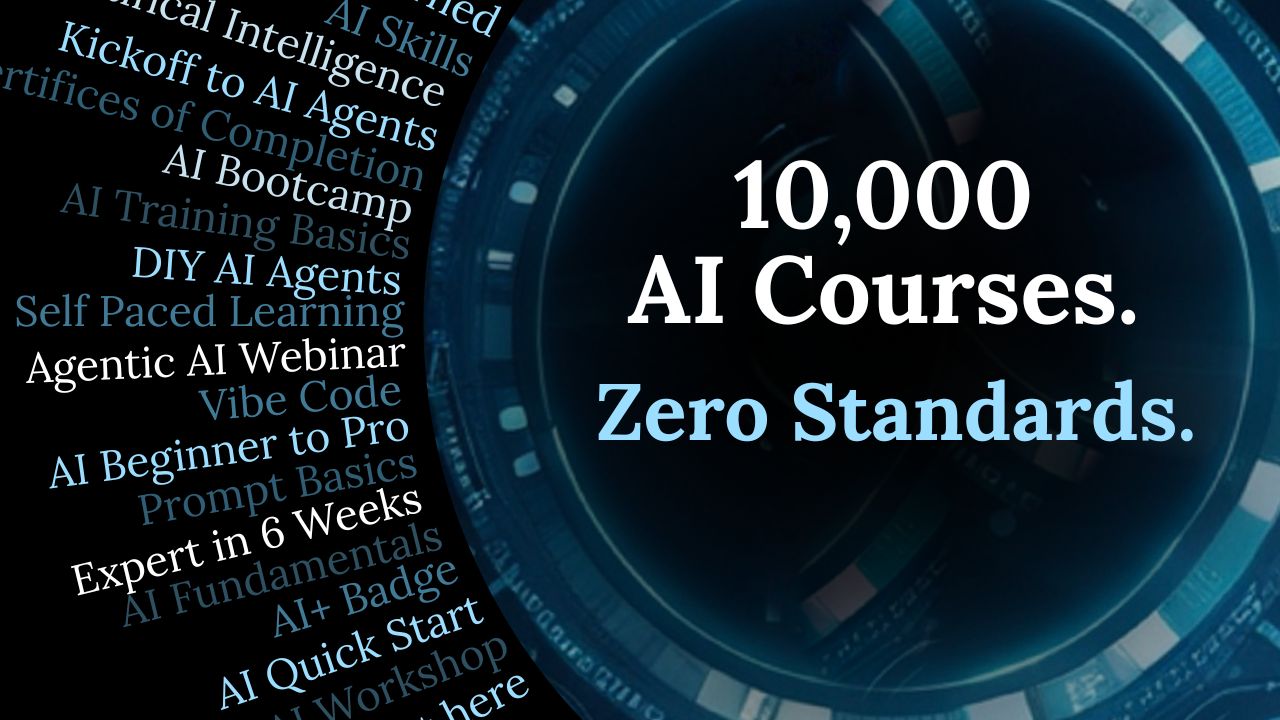
10,000 AI Courses. Zero Standards.
The IT industry just automated itself…and employers can't tell who actually knows AI
Simon Bunknell just posted something that I've been thinking for months … but he said it with the kind of blunt force that makes you sit up and pay attention.
"The IT industry has just made itself redundant."
Not all of it. But swathes of it.
I've been watching this pattern play out in real time. Not from the sidelines, but from inside organizations trying to figure out what the hell to do next. And Simon's right about one thing that most people still don't want to accept:
This isn't a normal downturn.
I've lived through enough cycles to know the difference. The dot-com crash. The 2008 recession. COVID disruption. Those were contractions. Markets corrected. Jobs came back. The fundamental structure of work remained intact.
This is different.
This is the IT industry eating itself from the inside out. Seven million people on LinkedIn UK alone marked "open to work." Most of them sitting there refreshing job alerts, waiting for things to "get back to normal."
They're waiting for a world that isn't coming back.
Why Does This Gap Look So Familiar?
I spent the last 5.5 years working in digital equity. My job was closing the gap between technology access and capability for communities left behind by every wave of innovation.
Here's what I learned: Access without capability is just expensive frustration.
You can give someone a device, an internet connection, even training materials. But if you don't build actual capability, the kind that's recognized, credible, transferable, you haven't created opportunity. You've just made the gap more visible.
I watched entire communities struggle not because they lacked access to technology, but because they lacked the frameworks, the roadmaps, the legitimized pathways to turn access into economic mobility.
And now I'm watching the exact same gap open up inside the IT industry itself.
Thousands of experienced professionals, people who built careers in QA, project management, product development, technical sales, are suddenly facing a market that's fundamentally revalued their expertise.
Not because they're not capable. But because the rules changed and nobody handed them a roadmap.
What Happened to the Entry Rung on the Career Ladder?
Simon put it plainly: "The IT industry just automated out the very people who built it."
The entry-level roles that once gave people their start, roles such as help desk, junior QA, project coordination and technical support are vanishing at a pace that should terrify anyone paying attention. These weren't glamorous jobs, but they were essential. They're how people learned the biz. How they built experience. How they proved capability and moved up the career ladder…the proverbial food chain.
AI is absorbing routine work faster than organizations can restructure around what's left. And the people caught in the middle are experienced professionals who followed all the traditional rules: build expertise, stay current, apply for jobs, wait for callbacks.
That playbook is broken.
The labor market isn't contracting and bouncing back. It's restructuring. And the roles that survive will require fundamentally different capabilities than what got most people here.
How Did We Get Here Before—And How Did We Get Out?
Go back 25—30 years.
IT wasn't a "career" yet. It was a position. You were "the computer person." The one who fixed the printer, set up email, maybe managed the server if your company was super-duper fancy.
There was no clear path. No framework. No way to prove you knew what you were doing beyond "I've done this before" and hoping somebody believed you.
The market was chaos. Everyone claimed expertise. Employers couldn't differentiate skilled technicians from people who'd just tinkered with computers more than the hiring manager.
Then something changed.
Organizations like CompTIA emerged and created standards. Tested, industry-recognized certifications that said: "This person has demonstrated competency in X."
Not just "took a class." Not just "has experience." But certified capability.
A+ certification. Network+. Security+. Suddenly there was a roadmap. You could start at helpdesk and see a path to network administration, systems architecture, security specialization. Technical track or strategic track. Entry level to enterprise leadership.
It legitimized the work. It professionalized the field. It gave people agency over their own career trajectory.
And it worked.
IT became a career path that built the middle class for millions of people. Not because the technology got easier. But because the pathway got clearer.
What's Different This Time—And Why It Matters More
We're at that exact inflection point again. Except this time, three things are fundamentally different:
1. The stakes are higher. Back then, if you didn't get certified, you just had a harder time getting hired. Now, if you don't build AI capability, your entire role might disappear. Not in 10 years. In 10 months.
2. The window is narrower. The IT certification frameworks took years to develop, gain credibility, become industry standard. We don't have years this time. The gap between "I understand how to work with AI" and "I'm waiting for things to settle down" is widening every single week.
3. The noise is deafening. Andreas Horn, IBM's head of AIOps recently posted about the AI training landscape. His opening line: "There are 10,000+ courses on AI. Most won't move the needle."
Think about that. An executive at one of the world's leading technology companies had to curate a list of nine courses worth taking because the market is so flooded with AI training that even experts can't navigate it.
Ten thousand courses and counting.
Google launched AI Essentials. Microsoft expanded Copilot training paths. Coursera reports 400% year-over-year growth in AI course enrollments. Udemy has thousands of AI courses that didn't exist two years ago. LinkedIn Learning added over 100 new AI courses in 2024 alone.
Everyone's got a course. Everyone's an "AI expert" now. Certificates of completion are everywhere.
And none of it means anything to an employer trying to hire someone who can actually do the work.
Why Can't Employers Tell Who Actually Knows What They're Doing?
Here's the problem with 10,000 courses and zero standards: When everyone has a certificate, nobody has credibility.
Most of these programs hand you a certificate for showing up. You watch videos. You complete modules. You get a PDF that says "Congratulations, you finished the course."
When everyone has a certificate, nobody has credibility.
But can you actually implement AI workflows? Build automation that doesn't break? Advise leadership on strategic integration? Differentiate between vendor hype and operational reality?
A certificate of completion doesn't answer those questions. It just proves you paid attention for a few hours.
This is exactly where IT was 30 years ago in IT. Chaos. Claims without proof. Employers guessing. Professionals struggling to differentiate themselves in a market that had no shared language for capability.
And just like before, the answer isn't more courses. The answer: Credentialing frameworks actually test and verify competency.
Industry-recognized certifications—not course completion certificates—that prove you can do the work, not just that you watched someone explain it.
What Does a Professional AI Credentialing Path Actually Look Like?
The certification frameworks that legitimized IT careers? They weren't built around a single skill.
They created roadmaps.
You could start with foundational knowledge and build toward specialization. You could choose a technical implementation track or a strategic leadership track. You could prove capability at each level and employers knew what that meant.

That's what's emerging for AI right now.
Global industry AI certification programs are starting to emerge. These are tested, standardized, portable credentials. The kind that differentiate professional capability from 'I took a webinar.
The kind that separates 'I played with ChatGPT' from 'I can actually transform how this organization delivers value.
The kind that create career pathways again. AI-augmented operations or AI-native product development. Technical implementation or strategic transformation leadership. Entry-level automation to enterprise AI architecture.
This is the CompTIA moment for AI. And the people who recognize it early will have first-mover advantage that compounds for the next decade.
The people who don't? They'll be competing against an infinite supply of "I'm a quick learner" resumes from people who also don't have frameworks, credentials, or differentiated capability.
Why Should Mid-Career IT Professionals Care Right Now?
Because the gap between "I completed a course" and "I'm professionally certified" is about to become the gap between employed and unemployed.
Simon's post hit hard because it's true. The IT industry automated the very people who built it. And most of them are still treating this like 2008.
Tighten the belt. Update the resume. Apply to 100 jobs. Wait.
While the market continues to automate the roles they're applying for.
I'm not saying this to be cruel. I'm saying it because I've watched what happens when people mistake a structural shift for a temporary downturn. I've seen entire communities (and sectors) fall further behind because they kept waiting for the old rules to come back.
The old rules aren't coming back.
But new rules are being written right now. And the people writing them are the ones who decided they're worth the investment of real skill-building, real credentialing, real professional development.
What Makes Me Furious About This Moment?
We know how to close gaps like this.
We've done it before! For IT careers, for cybersecurity specializations, for cloud architecture, for IT asset management, for project management professionalization.
We know that access without capability doesn't create opportunity.
We know that frameworks matter. Credentials matter. Roadmaps matter.
We know that people are worth investing in…especially when the market is restructuring around them through no fault of their own.
And yet most of the IT professionals I talk to are still approaching AI like it's optional enrichment.
"I'll take a course when I have time."
"I'm waiting to see which AI platform wins."
"My company will train me when they're ready."
Meanwhile, the market is moving. Challenger, Gray & Christmas reported nearly 55,000 U.S. job cuts attributed to AI in 2025, with over 31,000 occurring in October alone as the trend accelerated through the fall. Roles are disappearing. Requirements are shifting. And the gap between those who built real AI capability and those who waited is becoming unbridgeable.
I've spent 25+ years watching this exact dynamic destroy economic opportunity for communities (and industries) that didn't move fast enough to close capability gaps. And I'm watching it happen again, but this time to the professionals who built the technology industry itself.
And it's making me furious. Because we know better.
So What Does Moving Forward Actually Look Like?
If you've spent your career building expertise in IT…any part of IT…be encouraged. You're not obsolete.
But your value proposition shifted underneath you.
The question isn't whether you need to understand AI. The question is whether you're going to approach it like a professional discipline with frameworks, tested credentials, and strategic pathways, or wing it and hope.
One approach builds careers. The other extends job searches.
Simon's post was a gut-punch because it's true. The IT industry did automate itself. And most people are still sitting in the rubble thinking this is a normal downturn.
It's not.
But that also means the opportunity is extraordinary for people who move with intention.
We've closed gaps like this before. We professionalized IT when it was chaos. We created pathways when there were none. We built frameworks that turned "the computer person" into a legitimate career that supported millions of families.
We can do it again.
We just have to decide we're worth it.
Intrigued? Maybe a little nervous about the next 10 years? Good. That means you're paying attention. And you can do something about it.
If you're navigating this transition—whether for yourself or your organization—I'm working with leaders who are choosing the professional credentialing path forward. Let's talk.
DM me for details on globally recognized AI certification pathways and how to position yourself on the right side of this transformation.
This article benefited from AI-assisted proofreading...practicing what I preach about working with AI as a tool. The thinking, experience, and occasional fury? All mine.
Author's Note: This reflection draws on my 25+ years in IT asset management, business strategy, and digital transformation—including my recent work with Digitunity leading digital equity initiatives and helping organizations navigate the gap between technology access and strategic capability. The parallels between then and now are impossible to ignore.
This article was developed with AI-assisted drafting and editing, consistent with my belief that working with AI as a tool, not a replacement for human thinking, is exactly the point.