AI Needs Better Humans. We're Building Fewer of Them.
Your AI strategy assumes human skills will show up. That's a bigger bet than you think.
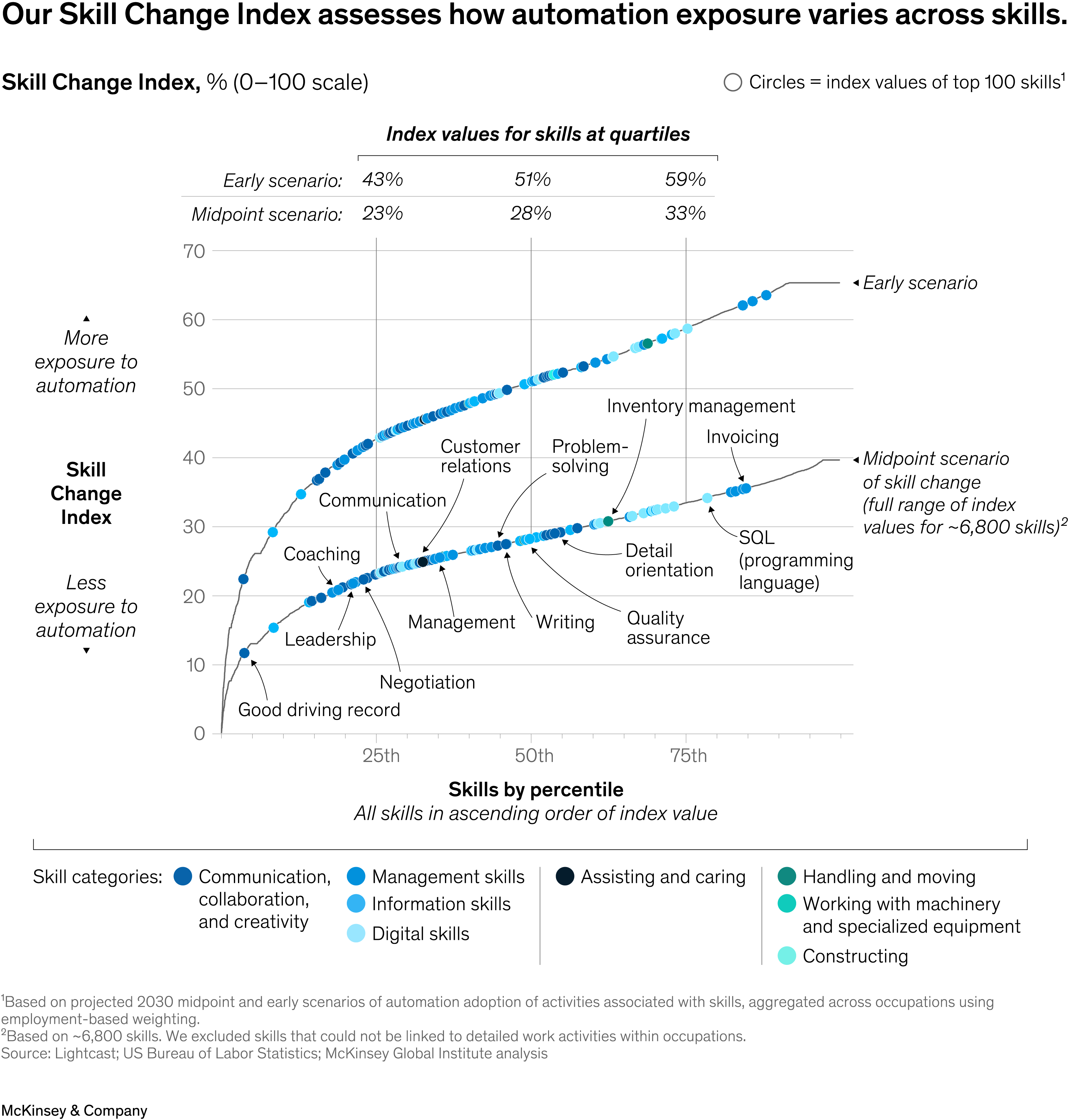
McKinsey's Skill Change Index just handed every executive a map. It shows which human skills survive automation, and the results aren't surprising. Leadership. Coaching. Negotiation. Stakeholder alignment. Problem framing. The deeply human stuff. Low automation exposure. High survival rate.
Great news, right?
Not so fast.
Knowing which skills survive doesn't mean your organization is actually building the conditions for those skills to work. And here's what the data doesn't tell you: at the exact moment AI is demanding more of these skills, most organizations are letting them erode.
That's not an opinion. That's the finding coming out of the Stanford Social Innovation Review this spring. Researcher Isabelle Hau calls it a "relational recession." Trust is declining inside organizations. Psychological safety, the foundation that allows leadership and coaching and honest problem-solving to actually function, is increasingly rare. Google's Project Aristotle found it was the number one predictor of team effectiveness. Microsoft's Satya Nadella built a cultural reset around it and watched collaboration scores jump 30% in two years.
Most leadership teams aren't doing that work. They're buying AI tools instead.
What Does the Data Actually Miss?
Here's the gap nobody is talking about.
Your AI strategy is essentially a bet. A bet that when agents handle more execution, your leaders will step up on problem framing. That when automation clears the tactical noise, your team will get sharper on trade-off decisions and stakeholder alignment. That the skills McKinsey says will matter most are ready to fire when you need them.
But you can't automate your way to clarity. And you can't install better judgment with a software subscription.
Andreas Horn put it well in a recent LinkedIn thread on the McKinsey data: if agents do more execution, humans do more problem framing, trade-off decisions, stakeholder alignment, negotiation under uncertainty. That's exactly right. But only if the conditions exist for those skills to actually work.
And that's the part most organizations are skipping.
Is Your AI Strategy Built on an Assumption You Haven't Tested?
I've watched brilliant leadership teams debate the same issues for the third month in a row. Not because they lack intelligence. Because nobody has done the work of getting clear on which problem actually deserves their attention.
The team has the skills. The organization doesn't have the clarity. So urgency fills the vacuum and the skills never fire.
What Happens When the Hard Work Lands on Unprepared Teams?
It shows up in unexpected places. Michelle Ragusa-McBain, Global VP of Channel Sales at Carrero and one of the sharper channel minds in technology, recently described an organization where market development funds sat at 8% utilization. The resources existed. The intent existed. The conditions to use them didn't. Different industry, same pattern.
This isn't an AI problem. It's a leadership infrastructure problem. And AI adoption is about to make it significantly more expensive.
Are You Building the Conditions or Just Assuming They Exist?
Think about what happens when agents handle more of the execution layer. The work that surfaces for humans gets harder, not easier. More ambiguous. Higher stakes. More dependent on exactly the skills you haven't built yet.
Problem framing without clarity is just expensive guessing. Stakeholder alignment without trust is just a meeting.Leadership without psychological safety produces decisions that die in the parking lot.
The meeting ends. Everyone nods. The decision dies in the parking lot.
The McKinsey index tells you which skills survive. It doesn't tell you whether your organization is building the right conditions for those skills to develop.
That's the real question.
Not: do we have leaders with these skills on paper?
But: have we built the environment where those skills can actually fire?
That means getting honest about where alignment is assumed but doesn't actually exist. Where decisions keep getting deferred because nobody has clear authority. Where the team is working hard on the wrong problems because nobody stopped to ask which problem actually matters most right now.
This isn't soft work. It's the hardest strategic work a leadership team can do. And it's the work that determines whether your AI investment compounds or quietly dies.
The organizations that will win the next decade aren't the ones with the most sophisticated AI stack. They're the ones that did the work that gets cut from every AI roadmap. Ensuring leadership clarity before the agents arrived.
So What Does Winning Actually Require?
The skills are there. The question is whether you've built the conditions for those skills to actually fire.
What are you seeing inside your organization? Are the conditions for these skills actually in place, or is your AI strategy running ahead of your leadership infrastructure?
In a follow-up piece, I'll be going deeper on what this looks like inside partner ecosystems specifically, where the execution gap is showing up in measurable ways and what leading teams are doing differently. Stay tuned.
This article was developed with AI-assisted drafting and editing, consistent with my belief that working with AI as a tool, not a replacement for human thinking, is exactly the point.