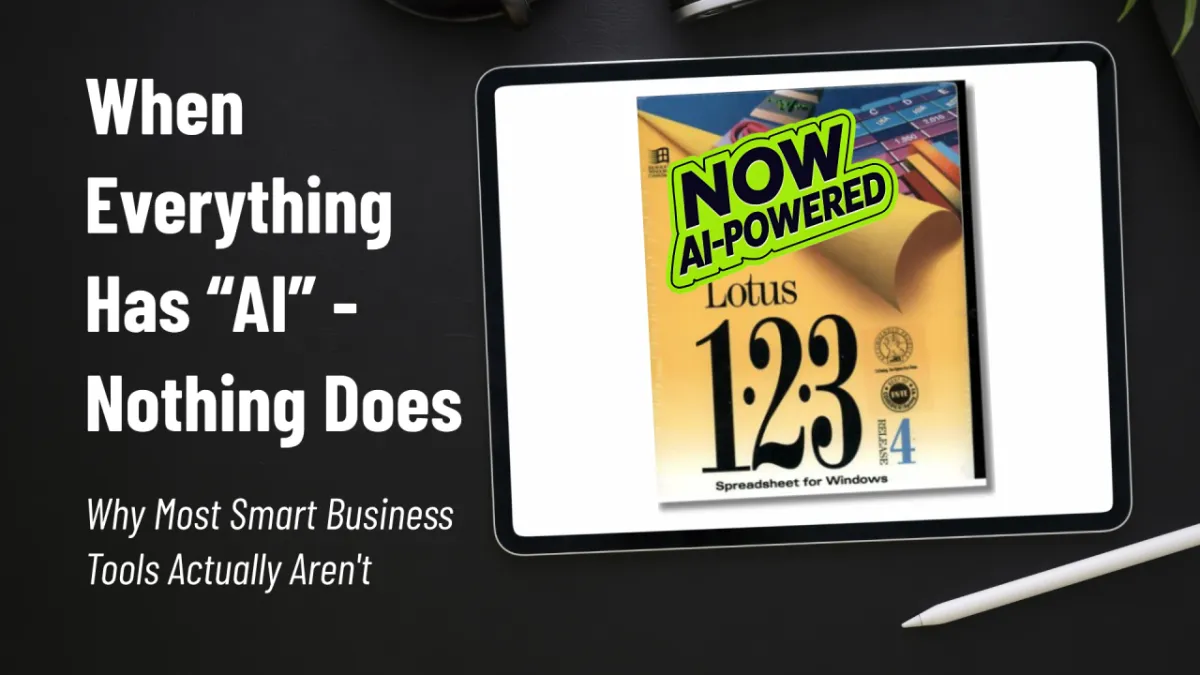
When Everything Has AI Nothing Does
78% of companies adopted AI. 80% report zero bottom-line impact.
We're living through the great AI gold rush of SaaS right now. Every platform, every dashboard, every customer support tool is suddenly AI-powered. The marketing emails are relentless. The demo calls are breathless. Everyone's got AI, and everyone's got to have it.
But here's the thing that's been nagging at me: most of it just feels like the same old automation with a shinier badge.
I've been watching this unfold across hundreds of platforms, and honestly? A lot of what's being called AI transformation is really just autocomplete with better PR.
Template-based content generation isn't strategic thinking
Rebranded dashboards aren't intelligence
Chatbots reading from help docs and static knowledge bases aren't the future of customer service
The data backs up this uncomfortable truth. McKinsey's latest research shows that while 78% of companies have jumped on the generative AI bandwagon, a staggering 80% report zero impact on their bottom line.
That's not a technology problem—that's a strategy problem.
Let's Get Clear on What We're Actually Talking About
Part of the confusion comes from the fact that AI has become a catch-all term for three very different things:
💬 Generative AI is what most people think of—tools like ChatGPT or Claude that can write, analyze, and create content when you ask. Think super-smart assistant that waits for instructions.
🤖 AI Agents go a step further. They don't just respond—they act. They can plan tasks, use multiple tools, interact with systems, and work through processes from start to finish with minimal supervision.
🧠 Agentic AI is where things get truly interesting. These systems have goals, memory, and the ability to adapt over time. Instead of "write me a summary," it's "monitor these 50 sources, identify emerging trends, update our systems, and alert me to anything game-changing."
Most of what's being marketed as AI-powered is just generative AI bolted onto existing interfaces and workflows. The real transformation happens when you move up the stack to truly autonomous systems.
We're Decorating, Not Renovating
Here's what I keep seeing: companies are bolting generative AI onto existing workflows instead of moving up the stack to truly autonomous systems.
Copilots that still require constant prompting (generative AI)
Chat features that mimic static help documentation (generative AI)
CRM tools that suggest actions but never actually take them (generative AI)
They're marketing these as "intelligent" solutions, but they're really just sophisticated content generators. We're still asking humans to initiate every interaction, supervise every process, and follow up on every outcome. The user experience hasn't fundamentally changed—it's just got more bells and whistles. That’s not the promise of AI. That’s busywork with smarter text.
It’s the software equivalent of launching a drag-and-drop website from a template. You can stand something up fast. But without a UI/UX strategy, a structure, and a goal—it’s still just surface-level.
The real work happens behind the scenes: rethinking what the platform needs to do, not just what it needs to look like.
Think about it: if your "AI-powered" tool still requires the same number of clicks, the same level of human oversight, and the same manual handoffs, you're probably dealing with generative AI masquerading as something more sophisticated.
What Intelligent Systems Actually Look Like
The companies that are seeing real results aren't just adding AI features—they're building agentic systems that actually think and act independently. McKinsey defines this as autonomous, goal-driven AI that's embedded into processes, not just slapped onto interfaces.
These systems don't wait for prompts. They coordinate steps across multiple tools and platforms. They adapt in real-time based on outcomes and changing context. And most importantly, they deliver results without constant human intervention.
The proof is in the results:
Major bank: Cut legacy system modernization time by 50%+
Research firm: Saved $3M+ automating quality control
Financial services: 60% productivity boost in credit processes
Notice what's missing from those success stories? No mention of "user-friendly dashboards" or "intuitive chat interfaces." The transformation happened behind the scenes, in the actual workflows and decision-making processes.
A Case Study in Thoughtful Implementation
One leader who's taken a refreshingly strategic approach is Matt Zimmer. Rather than chasing every AI trend, Matt has focused on two specific areas where AI creates genuine value:
Automating core operations for efficiency and cost savings
Elevating customer experiences through truly intelligent interactions
That clarity of purpose is exactly what's missing from most AI implementations. It's about having AI that actually moves the needle on your bottom line.
"We focused on automation where it mattered most—behind the scenes and at the user edge. The goal wasn't to add AI. It was to remove friction. That meant making systems think and act, not just suggest." ~ Matthew Zimmer
The Questions Smart Leaders Are Asking
Before you sign that next contract or approve that AI initiative, it's time to get real about what you're actually buying. Is your SaaS partner just relabeling existing workflows with an AI sticker? Are your agents actually acting...or just making suggestions that still require human follow-through?
The companies seeing genuine ROI aren't asking "What AI features do you have?" They're asking "What workflows are your agents executing, autonomously, today?" That shift in questioning separates real transformation from expensive theater.
If you can't get specific answers about autonomous processes and measurable outcomes, you're probably looking at interesting technology that won't move the needle on your bottom line.
Stop labeling features as AI. Start demanding business transformation.
The companies that will win aren't the ones with the most AI features—they're the ones moving up the stack from generative AI to truly agentic systems that deliver results without constant human oversight.
Everything else is just expensive decoration on the same old processes.
What's your experience been with AI implementations? Are you seeing genuine transformation or just shinier automation? Drop your thoughts in the comments!
This article was developed with AI-assisted drafting and editing, consistent with my belief that working with AI as a tool, not a replacement for human thinking, is exactly the point.